Molecular Kriegspiel
Concerns and hopes of a systems biologist on AI, biology, and the scientific fog of war.
By Noah Olsman
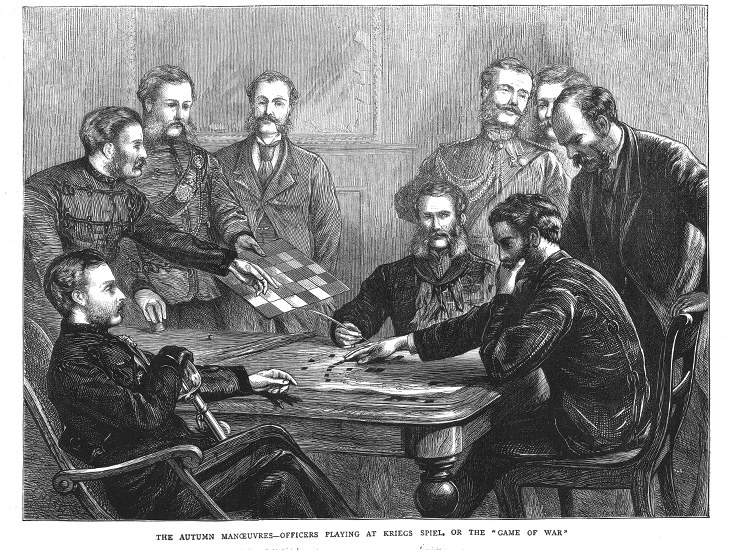
“The Autumn Manœuvres — Officers Playing at Kriegs Spiel, or the ‘Game of War.’”
There is a variant of chess, called Kriegspiel, where each player can see only their own pieces. The game is played with three boards: two players sit back-to-back and move their own pieces while a referee keeps track of both players’ movements and mirrors them on a third board. The players go back and forth taking turns and, each time, the referee tells them whether that move is legal, and if they took a piece. The identity of the taken piece is only revealed if it’s a pawn.
The name Kriegspiel, or “war game” in German, is meant to evoke a fog of war covering the board. I can barely play chess, so when I first heard of this game, my first thought was less how to win the game and more an amazement that the outcome of Kriegspiel could be anything but random chance, given how little information each player had. Each move in the game reveals limited information, and the wrong move can prove costly in ways you cannot possibly know until it is too late.1
Recently I have come to think that the differences between chess and Kriegspiel serve as a good metaphor for the gap between theory and practice in the life sciences. I entered biological research as a theorist who believed that enough mathematics could turn study of life into a game of chess: difficult, but ultimately legible. After spending years as an experimentalist, though, I have come to think that biology is much closer to Kriegspiel. We make moves (experiments) with only partial information, infer the hidden state of the board from sparse feedback (data), and often learn what mattered only after the consequences have unfolded, sometimes weeks or months later.
What I learned from starting to do experimental biology more than seven years ago is that, to quote the great 20th century philosopher of epistemology Mike Tyson, “Everybody has a plan 'til they get punched in the mouth.” Doing biology is unlike anything else I’ve encountered. No amount of planning and forethought can prepare you for the challenges you face when trying to study real living organisms. While there are certainly guiding principles and concepts, the reality of the work comes down to doing one painstaking experiment after another, each with a messy and uncertain outcome that can take days or weeks to materialize. We reason with limited measurements about systems we barely understand and whose behavior was shaped by forces in the past which we can never truly reconstruct. The most brilliant people in the field are generally not ones who are made famous by some singular deep insight that transforms how we look at some piece of data, but rather are tenacious and disciplined individuals who can wade through ambiguity long enough to piece together information that reveals something new about the living world. The whole endeavor is a molecular game of Kriegspiel.
But the rise of machine learning has brought real reasons for optimism about the future of biology: de novo protein design has opened up a world of new research directions that would have been implausible just a few years ago, LLM coding assistants have made it possible for researchers with limited bandwidth to rapidly create specialized computational infrastructure that may have otherwise taken years (or, more likely, just not have happened), and more broadly we now have the ability to finally train models that can make use of the massive data sets that are now being produced by state-of-the-art experimental methods. These tools have the capacity to greatly accelerate the pace of progress, with the potential to reduce the cost and labor involved in one of the slowest areas of science.
With all of this comes a familiar temptation: the belief that if we are clever enough, or wield enough computational power, we can finally see the whole board in biology. Advances in measurement techniques can make it appear that we now have direct access to the type and quality of data needed to automate the process of biological discovery, if only the right computational tools existed. But we often forget that a genome is neither a blueprint nor source code, that transcriptional state is a proxy for the cell’s state, but a coarse and distorted one, and that an accumulation of many terminal measurements of single cells is not a substitute for the direct measurement of a single cell’s dynamics over time. We might have better strategic options available now but we are still playing Kriegspiel, trying to find a path to victory using imperfect information and trying our best to uncover reality amidst the pervasive fog.
It feels like every day now we see a new startup promising to solve the core problem of biology by looking at all the pieces on the board, and using the latest computational methods to finally solve the big problems that have eluded previous generations of scientists who labor in the lab. What I find salient is that, for all the unfathomable money these efforts seem to be raising, few of these announcements involve a serious component of wet lab biology. They are yet again framing the problems of biology as chess, not Kriegspiel.
As an example, it seems to me that the term “virtual cell” has taken on a life of its own, yet most efforts to build these models seem to implicitly assume that the ability to predict a cell’s transcriptional state under a given perturbation is equivalent to modeling the cell. Or, if that isn’t enough, then we can stitch together enough diverse data sets to finally put Humpty Dumpty back together again. The reality that every experimentalist runs into when generating and interpreting this sort of data is that the results are more often than not confusing and ambiguous, and that much of the interesting science comes in figuring out how to reconcile the messiness that is biology.
I’m sure that we will continue to see amazing use cases for machine learning in biology, tools like AlphaFold and coding agents have already drastically changed the way I operate in the lab. That being said, I think many people are learning the wrong lessons from these early successes. AlphaFold is useful not because it totally resolved the field of protein folding, but rather because it greatly reduced the cost and effort required for an experimentalist to use structural biology in their research. Hardcore structural biologists still go out and do CryoEM when they want to study a particular protein, but now someone like me can spend an hour seeing if there might be structural insight into a problem, something I just wouldn’t have considered for any structure that wasn’t already in the PDB.
I would love to see a day where AI scientists are running autonomously for weeks or months on end to increase the pace of discovery, but I am yet to be convinced we are anywhere near that goal. The real value I see from AI tools in our game of molecular Kriegspiel comes not from planning twenty moves ahead, but rather making it so that we extract as much information as possible out of each uncertain turn.
To give a personal example, I have spent countless days of my life trying to navigate hardware, software, and driver configurations when trying to do something new with a commercial microscope. Even as someone with an unusually high tolerance for suffering through the debugging of technical issues, I still find myself constrained in how I design experiments by what I can easily implement with existing software. With current generation coding models I already find myself becoming more ambitious in what I am willing to try out, and I can imagine a future where every computer controlling a sophisticated piece of hardware is set up with an agent that understands how it is configured, what parts in the lab are compatible and how to switch them out, can guide the user in how to make their ideas a reality. This is the sort of tool that would never really show up directly in the results of a paper, but could dramatically change the day to day of how a scientist interacts with the tools at their disposal.
Rather than trying to develop the next Deep Blue or AlphaZero to solve chess, we need tools that will look at each move in a game of Kriegspiel and figure out how to make it a little less risky, a little more informative. To quote the great Bell Labs engineer Richard Hamming, “Knowledge and productivity are like compound interest…the more you know, the more you learn; the more you learn, the more you can do; the more you can do, the more the opportunity.“ So much of biology today is bottlenecked by the herculean effort required to get a new project up and running. I think the real acceleration we’ll see from AI in science will look less like monolithic models supplanting entire disciplines and more like what Dario Amodei originally described in Machines of Loving Grace, a proliferation of specialized agents tuned to a given lab or researcher’s needs, lowering the activation energy required to go from having an idea to testing it in the lab, and thus leading to many more shots on goal that could lead to a breakthrough.
1 I first heard about Kriegspiel from my undergraduate math professor, Solomon Wolf Golomb, who was a combinatorialist who looked like a wise elder hobbit and had a lifelong obsession with mathematical games. We had weekly research meetings which consisted of maybe 15 minutes of research followed by 2-3 hours of him telling me stories from his life. He invented a game called polyominoes that was the basis for what would eventually become Tetris, and he claimed to be the first person on the west coast to solve a Rubik’s cube (which I assume is true but have no real way of verifying). ↩