
Noah Olsman

Research Scientist in the lab of Johan Paulsson
building experimental platforms for quantitative synthetic biology

I'm a Research Scientist in the Department of Systems Biology at Harvard Medical School, working in the lab of Johan Paulsson. I build experimental platforms that make synthetic biology more quantitative and engineerable, combining ideas from control theory with high-throughput, single-cell measurement.

My main project is BARRACUDA, a platform for measuring how large libraries of synthetic gene-regulatory circuits behave inside living cells. It combines combinatorial circuit libraries, microfluidic time-lapse imaging, and optical barcoding to follow the dynamics of up to a million circuit variants in a single experiment — breaking a long-standing tradeoff between the throughput of sequencing-based screens and the resolution of live-cell imaging. I think of it as a kind of wind tunnel for engineering biology: a way to systematically map how molecular design shapes circuit behavior. Using it, I produced the first comprehensive design landscape of a feedback controller in E. coli and uncovered a hidden interaction between synthetic circuits and their host cells that can destabilize otherwise well-behaved designs. More recently I've been pairing the platform with generative protein design to build and test entirely new regulatory proteins in living cells.

My path here ran through engineering. I studied electrical engineering (and minored in mathematics) at USC, where an early interest in robotics gradually gave way to biology. After graduating in 2012 I spent a year in Thierry Emonet's lab at Yale modeling bacterial chemotaxis, then started graduate school at Caltech in the Control and Dynamical Systems group, co-advised by Lea Goentoro and John Doyle. My thesis developed theoretical tools for understanding how low-level molecular mechanisms give rise to high-level behavior in biomolecular circuits — the questions I now try to answer experimentally in the Paulsson lab.

Outside of my academic work, I am an avid guitar and mandolin player. I love American folk and blues music, and go to as many live shows as possible. I've also spent time on science outreach and pro bono work: I served as chief analytics officer for the nonprofit Seed Consulting Group, taught a summer course on communication and information theory for advanced middle school students through Math Academy, and taught extracurricular classes for elementary school students through Cambridge Math Circle.

Curriculum Vitae

Projects

Here are a few projects that I think are representative of my overall research interests, though I have been fortunate to be involved in many fun side projects listed in the Publications section.

Time-lapse of a synthetic circuit library growing in a microfluidic mother machine

Synthetic biology has a measurement problem: sequencing-based screens can compare millions of variants but collapse each to a single static number, while live-cell imaging captures the dynamics that matter but only for a handful of designs at a time. BARRACUDA (Barcoded ARRAys of Circuits Under Dynamic Actuation) breaks that tradeoff. It combines combinatorial circuit libraries, single-cell microfluidic time-lapse imaging, and optical barcoding to track how up to a million circuit variants respond, in real time, to controlled genetic and environmental perturbations — a wind tunnel for engineering biology.

Using the platform, I produced the first comprehensive design landscape of an antithetic integral feedback controller in E. coli, mapping more than 25,000 variants across a five-dimensional parameter space. The data also revealed something the idealized theory missed: under stress, a cell's own machinery can act back on its synthetic circuit and drive otherwise-stable controllers into unexpected oscillations — a hidden coupling between circuit and host that shapes how well these designs actually work.

This work is in collaboration with Jacob Quinn Shenker and Divya Choudhary, under the advisement of Johan Paulsson at Harvard Medical School.

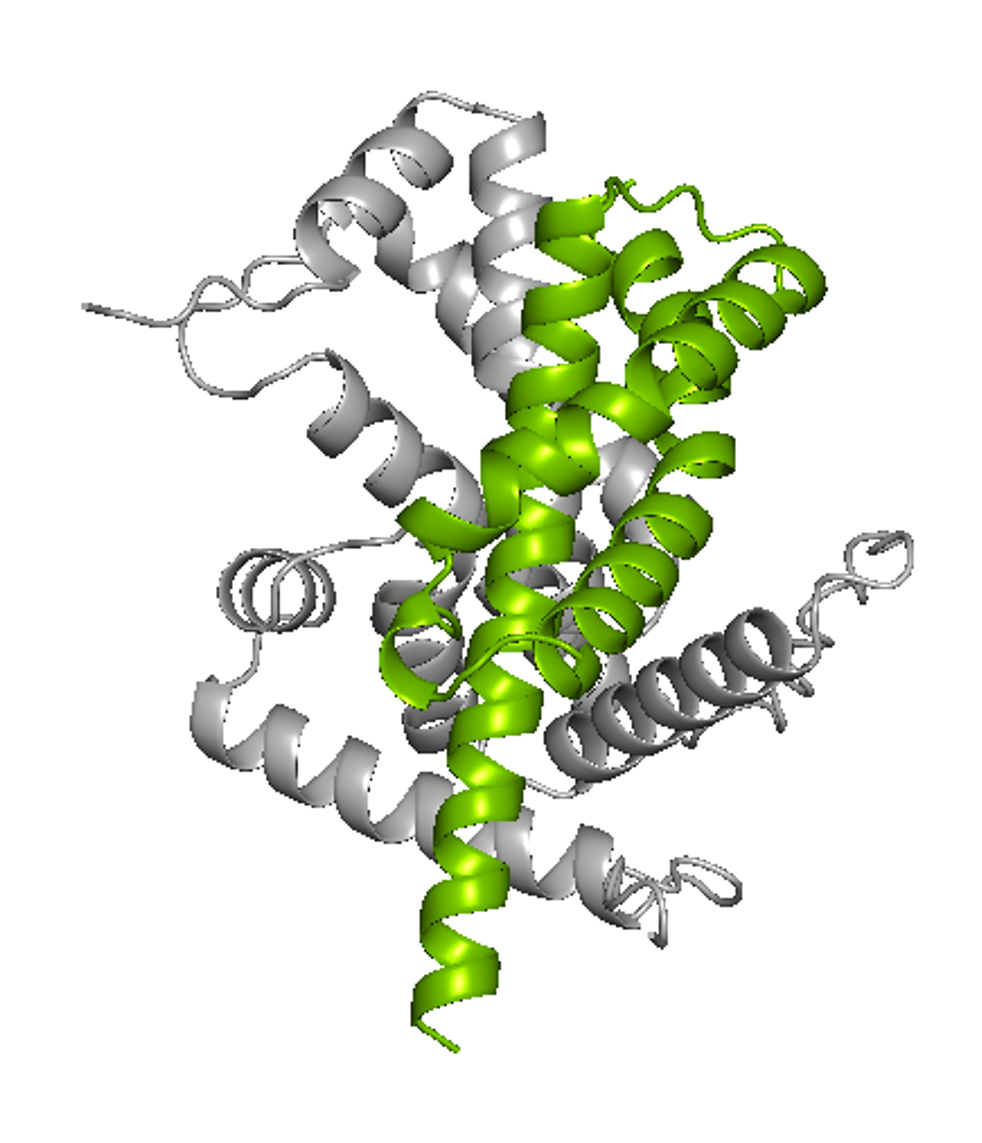
BoltzGen-generated de novo binder (green) modeled in complex with its target protein (grey)

Generative models can now design proteins that don't exist in nature, but a binder that looks promising on a computer can still fail inside a cell through weak activity, off-target effects, poor expression, or toxicity. Because BARRACUDA measures many of these properties at once and at large scale, it can evaluate designed proteins on the thing that ultimately matters — how they perform in a living cell — rather than on predicted structure alone.

As a first test, I used a generative binder-design model to propose tens of thousands of candidate regulators against bacterial sigma-factor targets, then built a library of thousands of variants to characterize the most promising designs in vivo. The best of them matched or exceeded the performance of the natural regulators they were meant to replace, while placing noticeably less stress on the host cell — evidence that new regulatory proteins can be designed and validated for cellular function, not just molecular binding. The longer-term goal is to close the loop: use these measurements to train models that predict not only which proteins fold, but which ones actually work in cells.

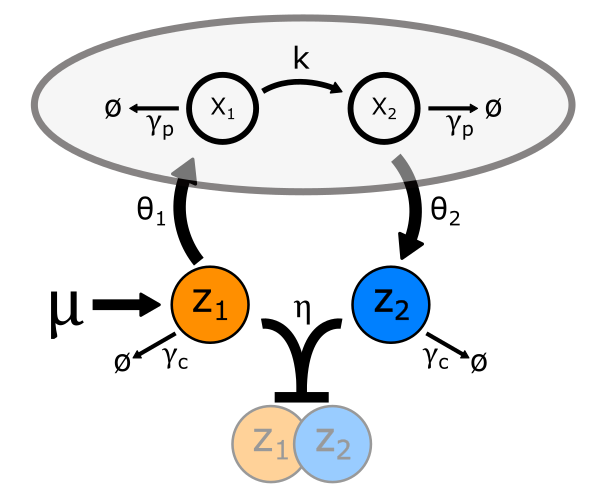
Homeostasis is one of the central processes that pervades all of life. Each organism must regulate its internal state, be it a warm-blooded vertebrate regulating its temperature or a single bacterium balancing its osmotic pressure. To do this, they generally rely on feedback control. While it has long been known that feedback control exists in biology all the way down to the molecular level, it has so far been difficult to engineer reliable feedback regulation into cells to perform synthetic functions.

This has changed in recent years, with the development of a simple mechanism for implementing precise adaption in cells known as Antithetic Integral Feedback (AIF). This mechanism has the fortunate properties of both being simple to design using known biological parts and having certain theoretical guarantees of its performance. Our work uses tools from control theory to describe a set of mathematical relationships that impose strict performance tradeoffs and hard limits on such circuits' behavior. These can be thought of a system of guidelines that can help to inform the design of synthetic biological feedback systems.

This work was published in two papers, one in Cell Systems and one in iScience. The work was done in collaboration with Ania Baetica, Fangzhou Xiao, and Yoke Peng Leong, with advisement from John Doyle and Richard Murray at Caltech.

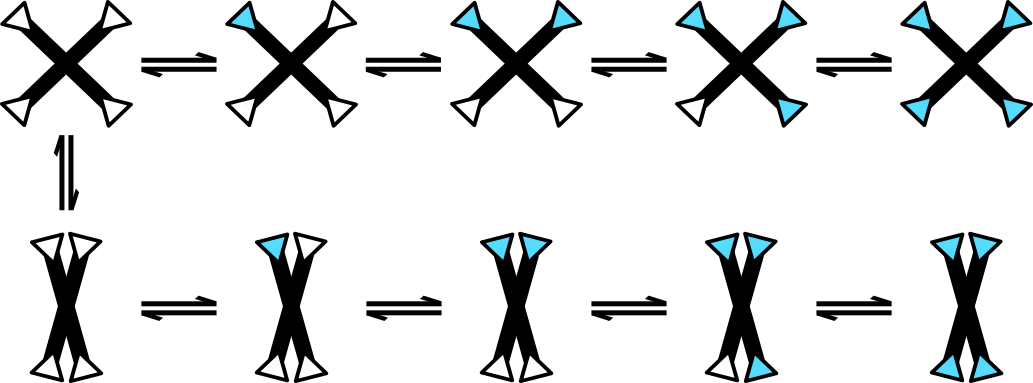
Sensory systems in biology are faced with two goals: they must be able to sensitively respond to changes in stimuli, while also being able to sense a broad range of possible intensities. One way that signaling systems can achieve both of these goal simultaneously is with a phenomenon known as fold-change detection, where the internal response of the cell is a function not of the absolute change in intensity, but the ratio of stimulus to background. This means that a cell can respond to a change from 1 to 3 just as well as it can respond to a change from 100 to 300.

We used mathematical models of protein dynamics to understand the molecular mechanisms that facilitate fold-change detection in real biological systems. This work was primarily with my Ph.D. adviser Lea Goentoro, and was presented at the 2015 Winter q-bio Meeting. It has since been published in the Proceedings of the National Academy of Sciences.

For a complete and current list, see my Google Scholar profile.

In Preparation

  1. Olsman, N., Shenker, J., Choudhary, D. and Paulsson, J., 2026. A Scalable Framework for the Design and Analysis of Complex Synthetic Gene-Regulatory Networks. In preparation.

Research Publications

  1. Olsman, N. and Forni, F., 2020. Antithetic integral feedback for the robust control of monostable and oscillatory biomolecular circuits. IFAC-PapersOnLine, 53(2), pp.16826-16833. [Paper] [PDF]
  2. Olsman, N., Baetica, A.A., Xiao, F., Leong, Y.P., Murray, R.M. and Doyle, J.C., 2019. Hard limits and performance tradeoffs in a class of antithetic integral feedback networks. Cell Systems, 9(1), pp.49-63. [Paper] [PDF]
  3. Olsman, N., Xiao, F. and Doyle, J.C., 2019. Architectural principles for characterizing the performance of antithetic integral feedback networks. iScience, 14, pp.277-291. [Paper] [PDF]
  4. Olsman, N., Alonso, C.A. and Doyle, J.C., 2018, December. Architecture and Trade-offs in the Heat Shock Response System. In 2018 IEEE Conference on Decision and Control (CDC) (pp. 1096-1103). IEEE. [Paper] [PDF]
  5. Al-Anzi, B., Gerges, S., Olsman, N., Ormerod, C., Piliouras, G., Ormerod, J. and Zinn, K., 2017. Modeling and analysis of modular structure in diverse biological networks. Journal of theoretical biology, 422, pp.18-30. [Paper] [PDF]
  6. Mossel, E., Olsman, N., and Tamuz, O., 2016, September. Efficient Bayesian learning in social networks with gaussian estimators. In 2016 54th Annual Allerton Conference on Communication, Control, and Computing (Allerton) (pp. 425-432). IEEE. [Paper] [PDF]
  7. Olsman, N. and Goentoro, L., 2016. Allosteric proteins as logarithmic sensors. Proceedings of the National Academy of Sciences, 113(30), pp.E4423-E4430. [Paper] [PDF]
  8. Al-Anzi, B., Arpp, P., Gerges, S., Ormerod, C., Olsman, N. and Zinn, K., 2015. Experimental and computational analysis of a large protein network that controls fat storage reveals the design principles of a signaling network. PLoS computational biology, 11(5). [Paper] [PDF]

Invited Publications

  1. Olsman, N., 2021. Cybernetics, systems biology, and the phenomenological gap. IEEE Control Systems Magazine.
  2. Olsman, N. and Paulsson, J., 2019. Universal control in biochemical circuits. Nature, 570(7762), pp.452-453. [Paper] [PDF]
  3. Olsman, N. Xiao, F. and Doyle, J., 2018. Evaluation of Hansen et al.: Nuance Is Crucial in Comparisons of Noise. Cell Systems, 7(4), pp.352-355. [Paper] [PDF]
  4. Olsman, N. and Goentoro, L., 2018. There's (still) plenty of room at the bottom. Current opinion in biotechnology, 54, pp.72-79. [Paper] [PDF]

Ph.D. Thesis

  1. Olsman, N. 2019. Architecture, Design, and Tradeoffs in Biomolecular Feedback Systems (Doctoral dissertation, California Institute of Technology). [Thesis]